
Reconciliation
The Sacrament of Penance and Reconciliation, more commonly known as Confession, is the sacrament by which Catholics confess their sins and receive absolution from a priest. It’s not the priest himself who forgives sins, but God administering his grace sacramentally through the priest. It’s this grace that strengthens penitent Catholics to remain in a state of grace, to be free from mortal sin, and in friendship with God.
Frequently Asked Questions
-
Please see our schedule for current times. Depending on the availability of priests, confessions may be heard during the weekend Masses.
Additionally, confessions may be heard by appointment.
-
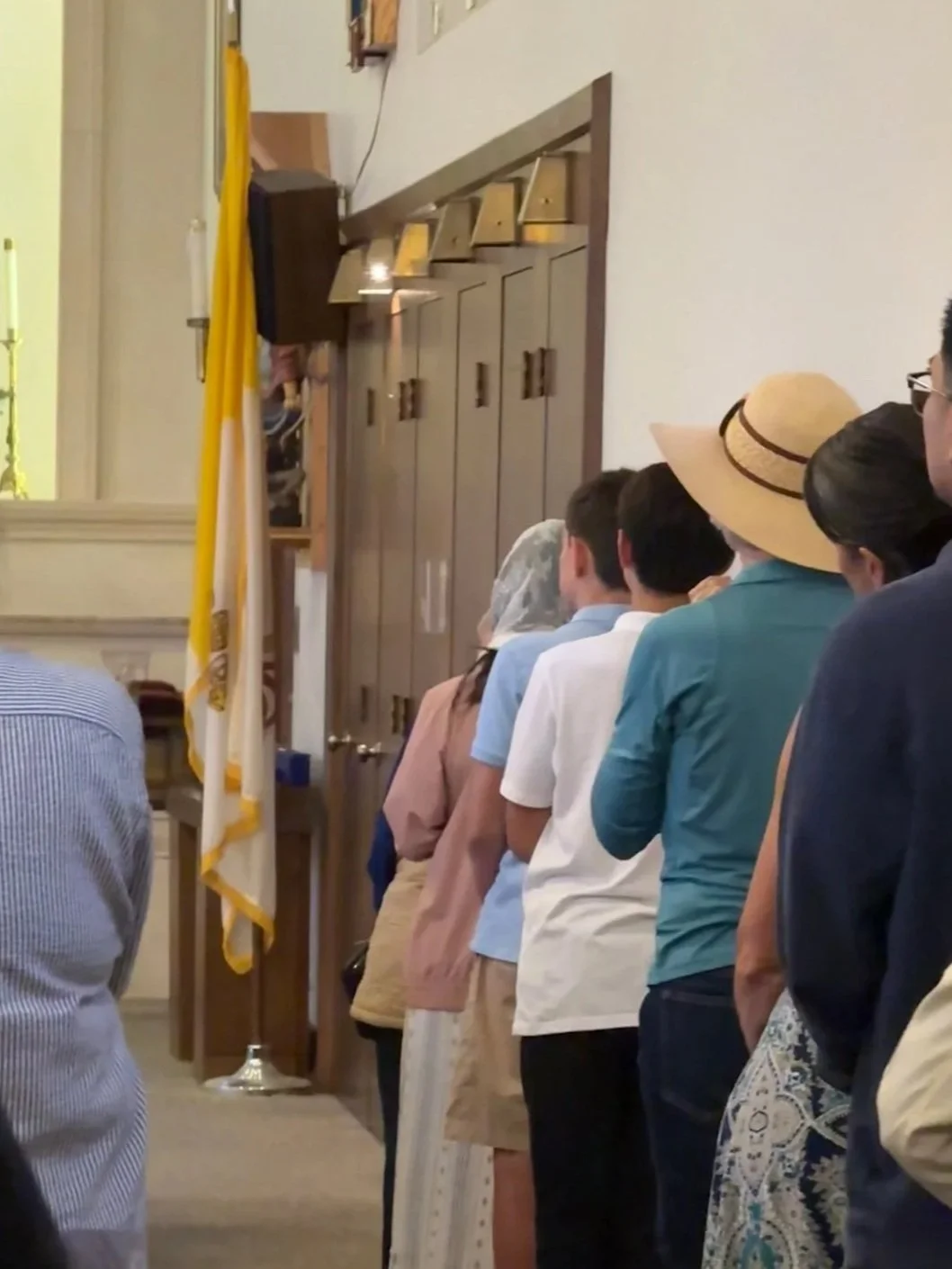
At St. Eugene’s, we alternate between the two confessionals on either side of the priest (this is the door with the white light above it). When the person before you exits the confessional, please enter the door opposite the one they’ve left. When you exit the confessional, please close the door behind you.
-
Begin “In the name of the Father, and of the Son, and of the Holy Spirit. Amen. Bless me, Father, for I have sinned. It has been _____ since my last confession.”
Confess your sins.
Finish by saying “For these and all my sins, I am truly sorry.”
Listen carefully if the priest gives you any advice, and remember the penance he gives you.
The priest will ask you to pray an Act of Contrition (example below):
O my God, I am heartily sorry for having offended Thee. I detest all my sins because I fear the loss of heaven and the pains of hell, but most of all because they offend Thee, my God, who are all good and deserving of all my love. I firmly resolve, with the help of thy grace, to sin no more and to avoid the near occasion of sin. Amen.
This prayer is posted inside the confessional in case you do not have it memorized.The priest says the words of absolution:
“…I absolve you from your sins, in the name of the Father and of the Son, and of the Holy Spirit,”Say “AMEN.”
The priest will dismiss you, saying something like: “Go in peace, your sins are forgiven.”
Say “Thanks be to God.”
Exit the confessional, and don’t forget to do the penance assigned to you.
-
Below is a brief Examination of Conscience based on the Ten Commandments:
I am the Lord your God: you shall not have strange Gods before me.
Have I treated people, events, or things as more important than God?You shall not take the name of the Lord your God in vain.
Have my words, actively or passively, put down God, the Church, or people?Remember to keep holy the Lord’s Day.
Do I go to Mass every Sunday (or Saturday Vigil) and on Holy Days of Obligation? Do I avoid, when possible, work that impedes worship to God, joy for the Lord’s Day, and proper relaxation of mind and body? Do I look for ways to spend time with family or in service on Sunday?Honor your father and your mother.
Do I show my parents due respect? Do I seek to maintain good communication with my parents where possible? Do I criticize them for lacking skills I think they should have?You shall not kill.
Have I harmed another through physical, verbal, or emotional means, including gossip or manipulation of any kind?You shall not commit adultery.
Have I respected the physical and sexual dignity of others and of myself?You shall not steal.
Have I taken or wasted time or resources that belonged to another?You shall not bear false witness against your neighbor.
Have I gossiped, told lies, or embellished stories at the expense of another?You shall not covet your neighbor’s spouse.
Have I honored my spouse with my full affection and exclusive love?You shall not covet your neighbor’s goods.
Am I content with my own means and needs, or do I compare myself to others unnecessarily?*Taken from the USCCB website.